


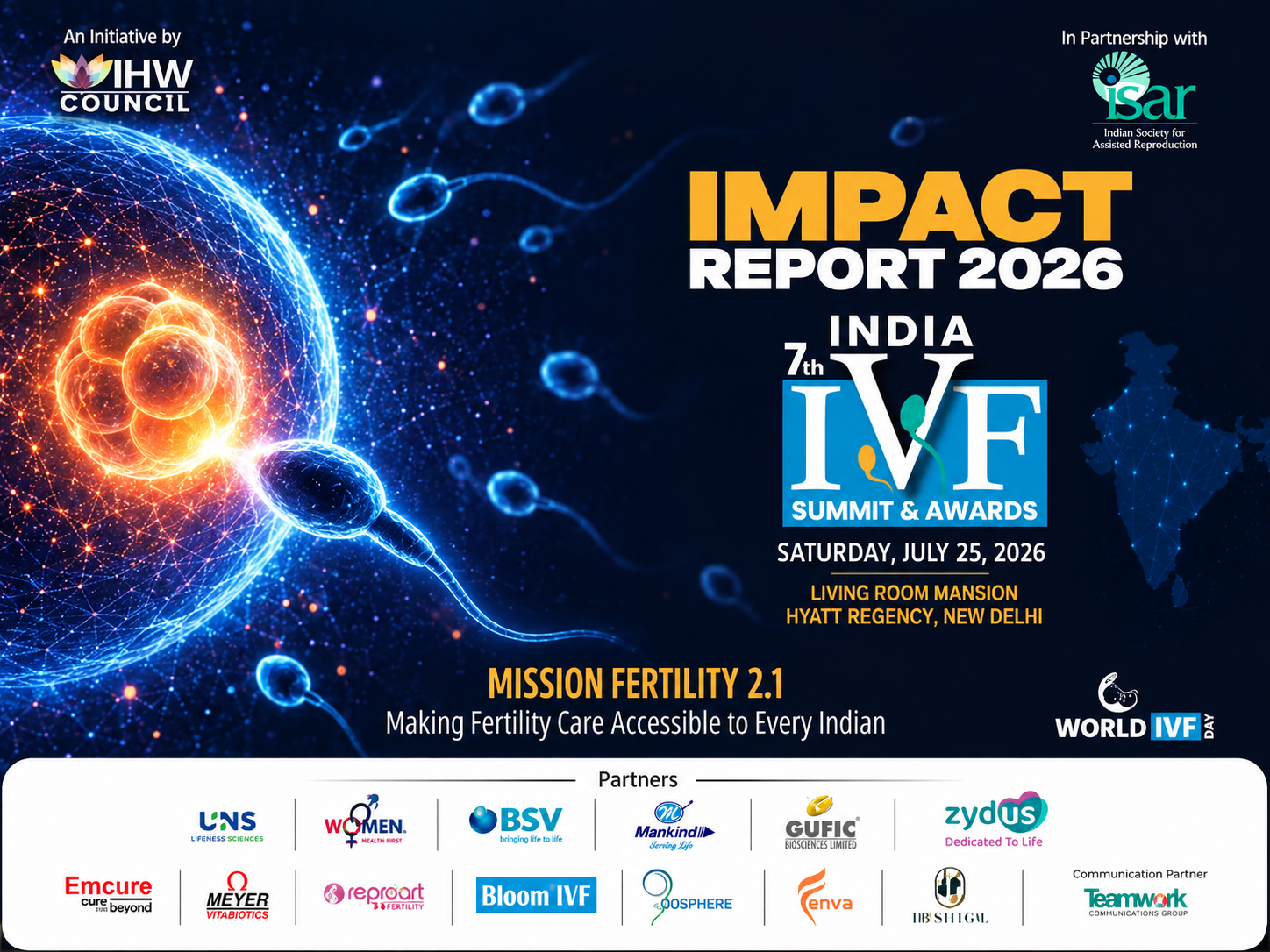
Against this backdrop, the 7th India IVF Summit & Awards 2026, convened by the Integrated Health & Wellbeing (IHW) Council in partnership with the Indian Society for Assisted Reproduction (ISAR), brought together clinicians, embryologists, policymakers, insurers, legal experts, industry leaders, and patient advocates on 25 July 2026—World IVF Day in New Delhi.
Held under the theme “Mission Fertility 2.1: Making Fertility Care Accessible to Every Indian,” the Summit shifted the conversation from advances in assisted reproductive technology alone towards the larger challenge of achieving equitable fertility care in India.
Closing India’s Fertility-Care Access Gap
India has developed considerable clinical expertise and fertility-care infrastructure, but access remains uneven.
The Impact Report estimates that India requires approximately one million IVF cycles annually, while only around 300,000–350,000 cycles are currently delivered. It also notes that approximately 85% of fertility infrastructure is concentrated in eight metro cities, leaving large sections of the population underserved.
The Summit discussions highlighted that infrastructure alone is no longer the only challenge. Awareness, delayed diagnosis, stigma, treatment affordability, financing, and inconsistent implementation of regulations are among the major factors preventing patients from receiving timely care.
This makes improving fertility care in India a multi-stakeholder challenge requiring coordinated action across healthcare, government, employers, insurers, and communities.
Mission Fertility 2.1: From Awareness to Reproductive Equity
A major milestone of the Summit was the launch of the white paper “Addressing the Burden of Infertility in India: Towards Reproductive Equity through Mission Fertility 2.1,” developed jointly by IHW Council, IIHMR Delhi, and ISAR.
The white paper proposed a five-pillar roadmap for improving reproductive equity: recognizing infertility as a core reproductive health condition and strengthening awareness; integrating fertility benefits into corporate employee wellness; reforming private insurance coverage; modernizing reimbursement under public schemes; and exploring state financing and public-private partnership models for underserved populations.
The roadmap proposes a sequenced approach—beginning with awareness and reimbursement reforms, followed by insurance and registry reforms—with a longer-term proposal for a capped fertility-care benefit within PMJAY for BPL and EWS families.
Bringing Fertility Care Closer to Patients
Geography remains an important barrier. The Summit explored how fertility services could expand beyond metropolitan centers into tier-2, tier-3, and other underserved locations.
Experts discussed stronger referral networks, public-private partnerships, independent practitioners, and technology-enabled care. Training gynaecologists, general practitioners, and ASHA workers as informed referral gatekeepers was also recommended to help patients reach specialists earlier.
The discussions also drew attention to male-factor infertility. Participants called for greater awareness around male fertility and more consistent diagnostic evaluation of male partners during fertility consultations.
Affordability and Insurance Need Greater Attention
For many families, the cost of treatment remains a significant obstacle. The report estimates an IVF cycle can cost approximately ₹1.5–3 lakh, potentially exceeding the annual income of some households. IVF is also described in the report as explicitly excluded from Ayushman Bharat–PMJAY.
The Summit therefore examined employer-sponsored fertility benefits, private insurance reform, and innovative financing models as possible ways of improving affordability.
A dedicated Corporate Fertility Roundtable brought HR, insurance, and clinical leaders together to discuss fertility benefits as part of employee wellness, directly advancing Mission Fertility 2.1’s corporate-integration agenda.
Breaking the Silence Around Infertility
Access is not solely a financial or infrastructure issue. Infertility can carry a significant emotional and social burden.
A dedicated Summit session examined stigma and the psychosocial impact of infertility, highlighting differences between rural and urban experiences as well as pressures associated with family expectations and career timing. Participants called for dedicated psychological counselling to become a standard component of IVF care rather than an optional service.
Normalizing conversations around infertility—particularly male infertility—was identified as essential to encouraging earlier diagnosis and treatment.
Quality, Transparency, and Patient Trust
As fertility services expand, ensuring consistent quality is equally important.
The Summit called for a national, standardized ART outcome-reporting registry, stronger accreditation and mentorship, greater transparency in reporting treatment outcomes, and quality and infection-control systems built into fertility centers from their inception.
Discussions around the ART (Regulation) Act, informed consent, data protection, and ethical practice further reinforced the importance of protecting patients while enabling responsible growth of the fertility-care sector.
From Aspiration to Implementation
The 7th India IVF Summit & Awards 2026 demonstrated that improving fertility care requires action well beyond the clinic.
Mission Fertility 2.1 brings together awareness, early diagnosis, affordability, insurance, regulation, quality, psychological support, and public-private collaboration within a broader reproductive-equity agenda.
The next phase is about translating these conversations into implementation—bringing government, clinicians, fertility specialists, employers, insurers, researchers, and industry together to help make scientifically sound, ethical, and quality fertility care more accessible to people who need it.
As India navigates changing demographic realities, the conversation around fertility must remain centered not only on national fertility rates but also on the individuals and families seeking the opportunity to access appropriate reproductive healthcare.
